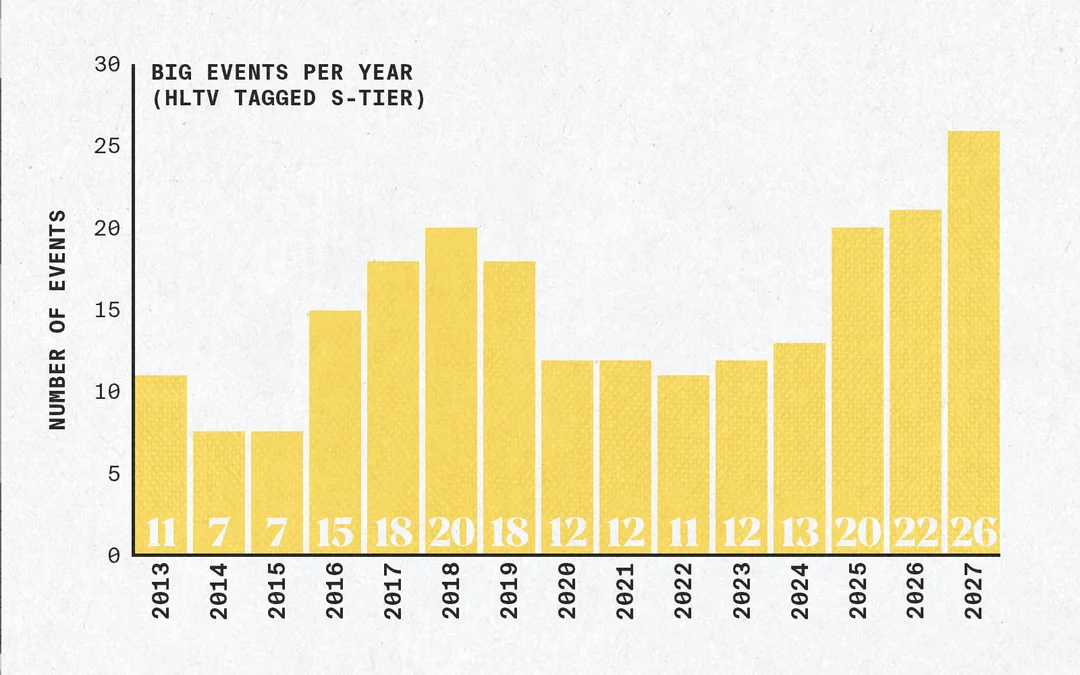
Every year we see more events in Counter-Strike, and every year we grow more apathetic to them as we weigh their values against each other. Fans and players alike are burnt out as a result of this, so how do we stop the rot?
Every sport is based on two things: competition and community. Right?
That takes time, a whole lot of money invested, and patience to see the tree bear some fruit. Take it from traditional sports: The men's Champions League - the biggest club tournament in football - had its first edition in 1955-56; the Women's Champions League, in 2001-02. The NBA started in 1946 (under the BAA name), while the first season of the WNBA was in 1997.
That's roughly a 50-year difference in both cases, and what we have now is: the men's UCL is the most-watched annual tournament in the world (despite being pay-per-view in a lot of countries) reaching more than 150 million views in the grand final alone, while the WUCL gets 45 million views in the entire season with matches being streamed for free.
The 2026 NBA Finals hit their best audience numbers since 1998, averaging more than 20 million views per game; the WNBA is also reaching new highs this year, with the All-Star game hitting 3.2 million on live TV and almost 20 thousand fans in the arena, surpassing the NBA All-star game attendancy for the first time ever.
Despite the lower numbers, the WUCL and the WNBA keep growing above 100% in the last couple of years, both in online viewership and in attendance. Both leagues are investing heavily in media and sponsorship contracts, lifestyle, social media content, and community grassroots strategies.
Growth and sustainability isn't simple
So what do we learn from these traditional leagues? Things take time, advertising, and community building to evolve and reach the point of being self-sustainable - and they're not even there yet.
In esports, we ideally could have the same future. But it looks like they are trying to shortcut decades of maturation process by spamming the calendar with tournaments in order to hit sponsors’ goals.
The industry is rather young, starting in the early 2000s. The most watched titles in esports are even younger: League of Legends was released in 2009, with its first World Champions being crowned in 2011. Counter-Strike is the oldest game, with its first variation released in 1999, and important tournaments starting in 2001. Mobile Legends: Bang Bang, the mobile god amongst the PC games, was released in 2016; VALORANT in 2020, and Dota 2 in 2013.
Now, talking specifically about Counter-Strike - which is the focus here; VALORANT can rot for all I care - this is what we are witnessing:
Tournament Organisers are making more and more tournaments in a small window of time - the same TOs that are also doing layoffs or delaying prize payments every year, btw. Each of these tournaments is being held in a different country, meaning expensive costs with logistics and personnel. These costs are expensive not only for them, but also for all the teams, and not all the teams take part in the prize pool.
A few CEOs and team owners have opened up about their finances and we learnt that even a tier-two team costs around $1 million per year. No wonder why we see some organisations around the world shutting down - names like ENCE, EG, Complexity, ODDIK -, and many others running in the red (as usual), not being able to profit even if in tier one.
Professional players are getting burnt out with the number of tournaments they have to play; they don't have time to celebrate winning a trophy on Sunday because they have a flight to catch on Monday for the next tournament.
“A lot of organizers make events on the player break. It's tough as a player right now because you have an event, to an event, to an event, to an event, maybe like 18 days off, or 17 days off, and then you get back into a very heavy season.”
Community wise, despite the ever-growing viewership number, the relationship between teams and fans seems to have weakened. Official fanclubs are walking away from their teams - or did their teams walk away from them? - like the traditional Danish Corner. Fans also complain about ticket prices to watch the playoffs in the arena (while watching it for free at home without even hitting the like button); but then again, there are so many tournaments now, that they don't really care to miss just this one.
What once was special became ordinary. The only tournaments that still hold some prestige are the Majors, Katowice (now gone), and Cologne.
When I think about all this, I remember one of the first concepts studied in economics classes: scarcity generates demand. Right now, we have a surplus, and that's not doing the Counter-Strike industry any good.
So, I have a lot of questions: Does filling up the calendar with more tournaments solve the money problem? Would fewer tournaments mean happier players? Would it bring back the prestige and the desire of the fans to actually watch the games?
Look, I love the game, we all do. It's amazing to turn on the TV every week and see r1nkle doing his best impression of a professional awper. But at some point we gotta start the conversation about how the calendar oversaturation is kind of a symptom of the free online broadcasts problem. AN1MO already gave one possible solution for the viewership revenue problem - a subscription model for regular circuits, while keeping the Majors free.
Everyone saw that clip of Spirit winning BLAST Open Lisbon and not celebrating… Why would they? Who's gonna remember that in 2 years? Who's gonna remember that FURIA won a bo5 against Nemiga when there weren't any fans attending the PGL Masters Bucharest?
While I understand that more tournaments mean more money and more VRS points, it also means more burnout to everyone involved. Is it possible to find a middle ground? Can we go back a few years when players would scream their hearts out when winning a trophy, and could actually enjoy their victory? When a big event was not just background noise on the secondary screen, but a spectacle that, when conquered, we'd love to rub in our rival's face?
I truly believe that, in this case, less is more. Deflate the number of LAN tournaments, or make them online, to cut costs. Give back to big events the prestige that made them big in the first place. Nurture and truly connect with the community, because then they will be happy to put their money where their hearts are.