Loading…

GUIDES
Simple Radar


© 2026 TLDR Media, All Rights Reserved.
Paying our respects to one of the GOATs (seriously)
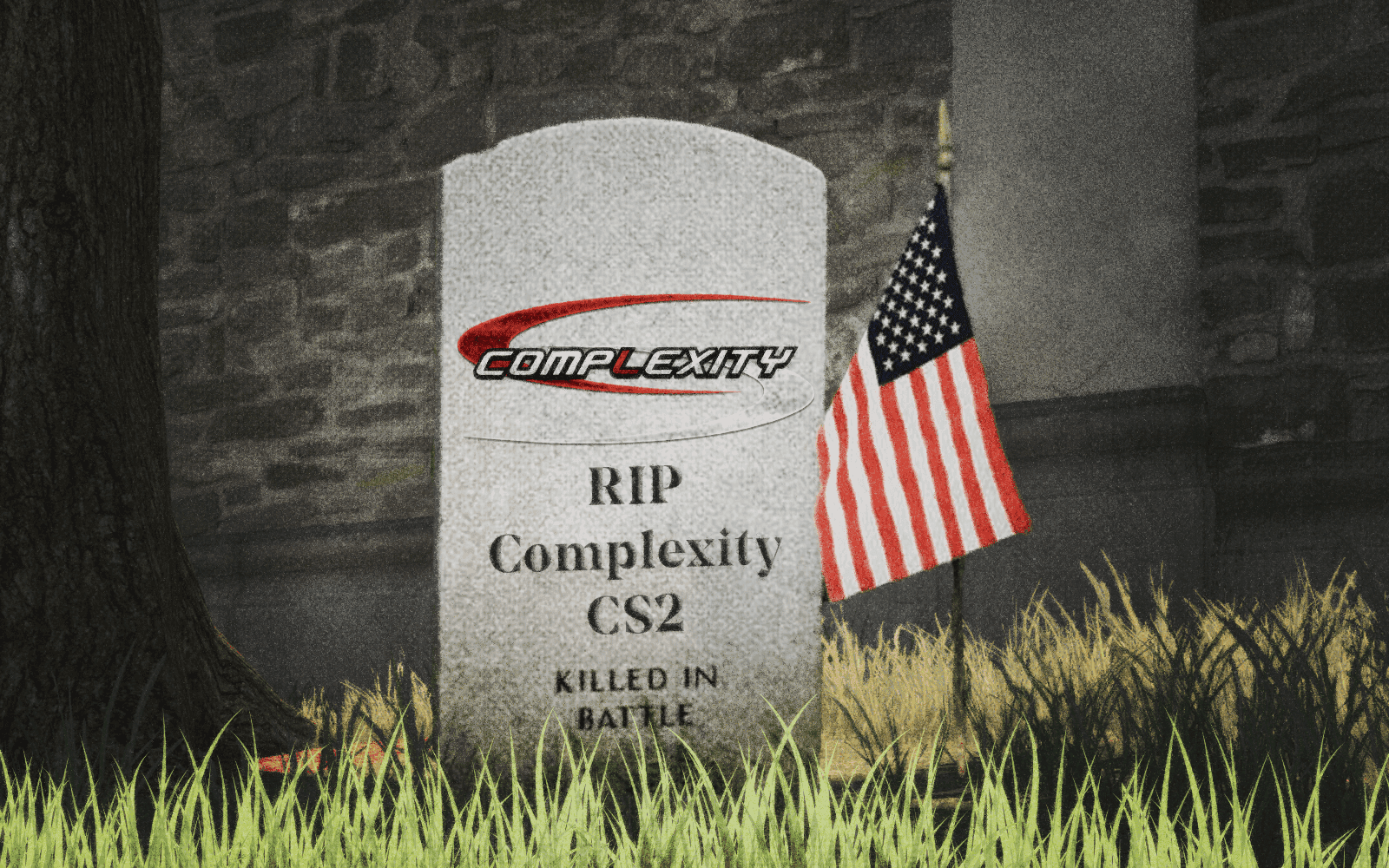
Complexity have left Counter-Strike, and we’re not just sad about that because we found their lineup to be amusing.
Spirit and NAVI did both lose in the first round of EWC, though, and that actually is pretty funny.

Now, we know what you’re all thinking: “How can they claim Complexity is best when we also have Cloud9 and Liquid?” But considering Liquid are dutch and Cloud9 haven’t been around in NA since their only good lineup nuked itself, we’re being serious.
Complexity are the greatest organisation in the history of North American Counter-Strike.
An organisation that is foundational to the idea of professional esports within the continent, they were there from the very early days, and they were very good too.
So good in fact, that they’re still the only NA team to ever win a Major outside of NA soil. It might not be the Valve-sponsored Major most of you recognise, but ESWC 2005 was a seriously big deal, and the achievement of sunman, Warden, Storm, tr1p, and fRoD is not something to brush off as irrelevant history.
They would win big again, at CPL Summer 2006, and remained a top team within CS: Source even if CGS would ultimately damage the NA scene - but more on that later.
In later years, as success with an NA lineup became harder to come by in the fallout of CGS, Complexity would briefly become Brazilian, calling itself home to familiar SA names like fnx, bit, nak, and a certain all-timer known as FalleN.
Eventually, though, they would transition back to their roots, signing an NA roster that consisted of Hiko, n0thing, swag, seang@res, and Semphis. The roster would see them place top four and top eight at the first two CS:GO Majors, but would eventually move on and head over to Cloud9.
From that point up until the Juggernaut was formed, new faces in the NA region would often find themselves honing their craft wearing the Complexity jersey, and players like autimatic, SicK, oBo, ANDROID, ShahZam, and stanislaw would all see themselves shine for the team. They weren’t always there at the beginnings of their career,
And we get it, you might want to laugh at some of those names, but one of them went on to win a Major and three of them played for Complexity in a Major quarter-final. We won’t laugh at that.
Fast-forward to the collapse of the failed Juggernaut project, and Complexity once again made itself the home of a North American Counter-Strike roster. A long and arduous road followed, with many players coming and going, but it was a lineup that allowed the organisation to stay true to their core values and history.
And that’s just it. Complexity, for all of the times they may have given us a reason to laugh at them, have always been the NA Counter-Strike organisation.
Whenever they could be, Complexity have stuck by the region they call home, and given everything they possibly could to try to get that region back to the highs they enjoyed during the formative years of the esport, even if it meant that they would eventually have to exit the game altogether.
And that’s where, for now at least, this story ends, with the North American Counter-Strike organisation departing the game it was founded in because the ecosystem no longer allows them to operate within it.
It’s a sad week, and not because one of our favourite modern punchlines is gone, but because some things are bigger than our jokes – it’s a really small list – and this is a gut punch to a region that could really do with being helped up, not kicked while its down.
But we really do feel like this isn’t the end of the Complexity story, so we look forward to the day we get to tell it again.

It’s not Overtime on Inferno unless we question whether someone is good or not, and this time Jack and Sam have decided that their target is HLTV.

The wait is finally over, the EWC has begun!
One of the biggest highlights in the CS calendar is here, and we’re all set for unforgettable clashes. With roaring crowds bringing the energy in Riyadh, the stage is set for epic showdowns you won’t want to miss!
(For disclosure purposes to the EU Comission’s Directorate-General for Financial Services, the above paragraph was sponsored by the Public Investment Fund of Saudi Arabia. Delete this addendum before publishing).
Relax, we’re kidding. No Saudi money here. Not yet, anyway. At the rate they’re throwing money at everything that moves, who knows how long we’ve got left.
Now, getting to what really matters, Counter-Strike.
We’ve gotta say, what we’ve seen over the past two days has been genuinely exciting. They’ve been packed with storylines and upsets, so we’ll do our best to highlight the main ones.
Let’s kick things off with G2 vs Falcons. NiKo and m0NESY facing their former team. Given their history, we were hoping for a bit more excitement from the match itself.
For some reason, NiKo nerfed himself during Cologne by playing 16:9, but now he’s back to the trusty 4:3, and let’s just say he should stick with it. He and m0NESY swept G2 without much effort, in what was a stinker of a match for pretty much every G2 player.
But honestly, the playing field wasn’t level. Falcons had a huge advantage. They played at home, with their loyal fans $upporting them every step of the way. They even brought out a tifo. The Golden Hornets finally have some serious competition.
On the contrary, the HEROIC vs Spirit matchup was one we had our eyes on and didn’t disappoint. Somehow, some way, HEROIC managed to pull off the win.
Just to be clear: HEROIC - playing with Alkaren, a Spirit Academy graduate making his tier one debut, without their coach who was off getting married, and tN1R, who’s leaving the team to join the very squad he was facing (and destroying) - defeated the team that had just won IEM Cologne and BLAST Bounty back-to-back, ending their 10-series win streak. Not even Shakespeare could’ve come up with this one.
The reality is HEROIC got lucky. They happened to play Spirit on one of the three days of the year when donk isn’t posting 1.50+ ratings.
But it wasn’t all upsets in the Middle Eastern lands.
In yesterday’s two quarter-final series, Vitality and The MongolZ sent TYLOO and 3DMAX home. Vitality made quick work of the Chinese, with a monster 2.69 performance from ZywOo on the first map, setting the tone for the rest of the (short) series. The MongolZ, meanwhile, struggled a bit against the French, but ultimately secured their semi-final spot. Maybe they should ask the Brits for some tips.
So, to recap: the teams eliminated right off the bat in the round of 16 were Liquid, Astralis, GamerLegion, Virtus.Pro, G2, FaZe, NAVI, and Spirit.
If someone had told us just six months ago that these would be the first teams eliminated from an event, we’d have called them crazy. Along with a few more colorful things we won’t repeat here. **
Man, if you don’t like reading about Complexity, you really opened the wrong newsletter today.
We focus on a single player for First Game/Last Game segment, but today it seemed right to do it for a whole org.
There’s just one issue; Complexity are older than at least 20% of our readership (that’s probably not even an exaggeration), and so their real first game is shrouded in mystery.
The earliest we can find is a BO1 win over MOUZ at CPL Winter Championship in 2004, with a line-up of Storm, fRoD, Warden, Bullseye and tr1p - two of whom you’ve probably heard of. We can’t find many details on this though, so we’re going to cheat a little and talk about their first CSGO game - another win.
By this time, they’re running a roster of n0thing, Hiko, seang@res, swag and SEMPHIS. That’s NA CS heritage right there. That’s half of every single ‘Best of NA FPL’ video from 2016 that gets played at every boys night in.
That might just be us.
These were the halcyon days; nothing was fragging out, Hiko was still good, seang@res was calling masterfully, SEMPHIS hadn’t discovered Mike Israetel’s YouTube channel yet (if you know, you know), and swag was a highly rated 16 year old.
Complexity put cuLtivation to the sword in a swift 2-0 on Inferno and Mirage, which is unsurprising given cuLtivation had players like… wait, hang on…
Warden, Storm and fRoD all played AGAINST Complexity in this game, nine years later. Small world.
Their final game, however, was less nostalgic, fun and full of hope. This was a sad exit. Complexity have been underwhelming for a while, and their bow out of Counter-Strike comes in the form of a narrow loss against HEROIC.
That result itself isn’t that bad, obviously, it’s more that it’s just… that’s the sort of game you look at as a Complexity fan and think “there were some good signs to take heart from and work on a few things, we’ll improve an-” but before you can finish the thought, they’re gone.
No potential, no more dreams, no more hope. Complexity leave Counter-Strike with a feeling of being nearly good, again. “Showing good signs but…” will be the words on their tombstone.
For what its worth, Grim and nicx carried on playing the music as the ship sank. Both dropped 60+ in the final series, but just fell short - the story of Complexity in the last few years.
Goodnight, sweet prince.
The cloud that is currently cast over NA CS is vast. And it’s dark. And right now it looks like it might never go away.
But we’re here to remind you that it will.
The butt of Counter-Strike related jokes for as long as we can remember, no one expected Cloud9 could ever win a Major, and it was definitely unexpected when Liquid usurped Astralis and completed a Grand Slam run in a time that will likely never be beaten. But those things both happened.
This dark period might feel like it’s been here for a long time, and for some of you reading this, you might never have known an NA without a cloud over it. It first appeared some time around COVID and the release of VALORANT, which we have to constantly remind ourselves was now five years ago.
Dark times.
But it isn’t the first dark period NA CS has had to endure. From winning ESWC 2005 and CPL Summer 2006, NA sunk in the wake of CGS, an international event that aired on American TV and forced teams to move over to CS: Source.
It was meant to be part of a boom for Counter-Strike esports, but it ultimately failed, and the players who called time on their careers as a result of its franchise and relocation model left NA without many of its most experienced figures.
Sound familiar?
It all seemed very bleak back then, perhaps even bleaker than it does now, but NA still managed to bring itself back from the brink. A new wave of players rose up, and those players went on to be Grand Slam champions. Major champions. They wrote their names into Counter-Strike history for the rest of time.
For all we know, NA’s real peak in CS hasn’t even happened yet. Who knows what players might rise up, or what the current crop of players might be able to activate in them.
NA isn’t without hope. It never has been. It’s just going to take the right people and some time.
And given how large NA is and how long CS has endured in an incredibly turbulent industry, we’ll say that they’ve got plenty of both.


